

Not all cities are upgrading their homes at the same pace—and the gap is bigger than most people expect.
A recent snapshot of U.S. real estate listings shows a striking divide: in some cities, smart security is everywhere. In others, it’s almost nonexistent. This isn’t just about tech—it reflects how different markets value safety, convenience, and modern living.

The Cities Where Smart Homes Dominate
At the top of the rankings, one thing is clear: smart home technology is no longer an upgrade—it’s becoming standard.
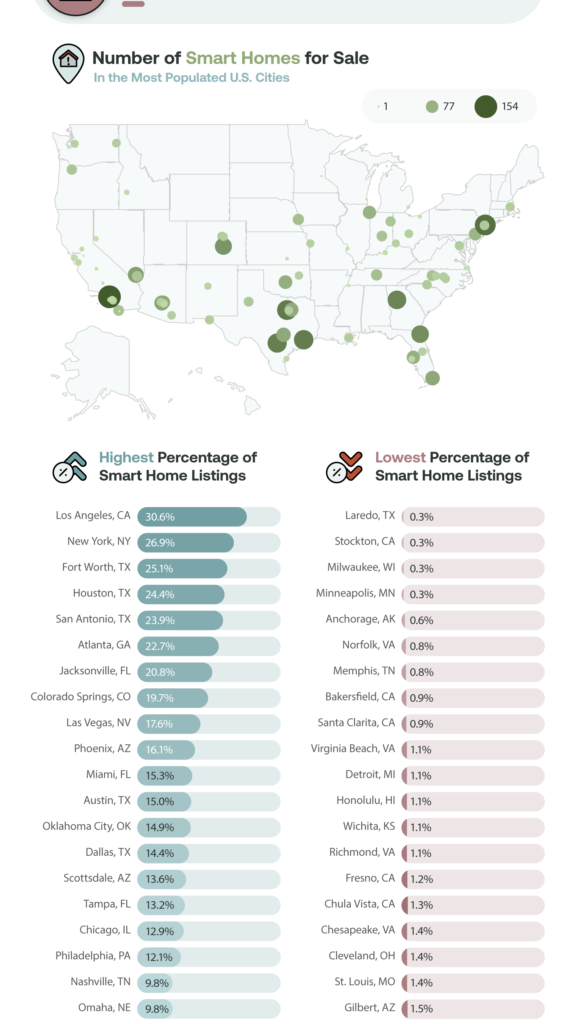
Leading the pack is Los Angeles, where over 30% of homes on the market include smart features. That’s a massive share, signaling that connected security systems are now part of the baseline expectation.
Close behind is New York City, where space is tight and security matters more than ever. Smart locks, cameras, and remote monitoring tools are especially valuable in dense urban environments.
Texas stands out as a powerhouse region. Cities like Fort Worth, Houston, and San Antonio all rank near the top, showing strong demand for integrated home tech in fast-growing housing markets.
What ties these cities together isn’t just population—it’s momentum. New construction, competitive housing markets, and tech-aware buyers are pushing sellers to include smart features upfront.
The Other Side: Where Smart Tech Is Nearly Absent
Now for the surprising part.
In several cities, smart home listings barely register. Places like Laredo, Stockton, Milwaukee, and Minneapolis sit at just 0.3%.
That means fewer than 1 in 300 homes on the market mention smart features.
Even cities such as Anchorage and Memphis remain below 1%, suggesting that smart home adoption hasn’t yet become part of the selling strategy.
This doesn’t necessarily mean people aren’t using the tech—it often means it’s not being highlighted, installed at scale, or seen as a value driver in real estate listings.
A Divide Shaped by More Than Technology
The contrast between high- and low-adoption cities points to deeper trends:
- New vs. older housing
Cities with newer developments tend to integrate smart systems during construction, while older homes require retrofitting. - Market expectations
In competitive cities, sellers use smart tech to stand out. In slower markets, it’s still viewed as optional. - Buyer awareness
In some regions, buyers actively look for smart features. In others, it’s not yet part of the checklist.
What Buyers and Sellers Should Take From This
If you’re selling in a high-ranking city like Los Angeles or Phoenix, skipping smart upgrades could put you behind competing listings. Even basic additions—like a video doorbell or smart thermostat—can influence perception and price.
On the flip side, buyers in cities like Detroit or Cleveland have a unique advantage. With fewer pre-installed systems, they can build their own setup from scratch—choosing newer, more flexible technology.
Where the Market Is Headed Next
Mid-tier cities such as Nashville and Omaha—currently sitting just under 10%—could be the next wave of growth.
As prices drop and installation becomes easier, the gap between “tech-heavy” and “tech-light” cities will likely shrink. But for now, the divide is very real—and very telling.
Smart home security is no longer just about convenience—it’s becoming part of how homes are valued and marketed.
Some cities are already there. Others are just getting started.
And that gap? It’s one of the most interesting shifts happening in real estate right now.